Monday, May 23, 2011

Buying used diapers

A great way to save on the start-up costs of cloth diapering is to buy used diapers. No matter how you slice it, using cloth diapers is far more economical than using disposable diapers, however, paying for them upfront can require a significant investment, depending on what style of diaper you decide to use. If you do decide to go the 'used' route, here's a few tips to ensure you make a good purchase. When you purchase used diapers, they won't come with a 30 day return policy, so you want to make sure you get it right!


Buy used diapers in person. There are lots of great online venues where you can buy used diapers (Kijiji, Craigslist, and various online parenting forums), however, seeing used diapers in person gives you a chance to assess the quality of the diapers. Even though an online listing may be accompanied by pictures, it's no comparison to inspecting the diapers in real life -- things like diaper cream residue, or delamination would be hard to see in a picture. We hold regular cloth diaper swaps at our stores that give our customers an opportunity to sell their use diapers -- for those in the market for used cloth diapers, it's a great opportunity to buy well-known brands of cloth diapers.


Buy used diapers at a consignment store. Admittedly, this may be a bit of a longshot, but it's always worth looking. Most consignment shops don't know the proper value of name brand diapers, as a result, if you're lucky enough to stumble upon a name brand diaper, you'll probably get it for a song. A customer came into our store last week who managed to snag a number of almost-new bumGenius 4.o diapers for -- wait for it -- $4.00 each. Is it weird that I wanted to high-five her?


Buy name brand used diapers. If you buy used diapers that have a good reputation, there's a better chance you will be happy with them (there's a reason they have a good reputation, after all!). If you're unsure about a particular brand, go to a cloth diaper review site to see what other people think of the brand you're considering purchasing.


If the used diapers are under warranty, ask for the original reciept. It's not unusual to buy used diapers from new parents who have changed their mind about using cloth diapers. In this scenario, the diapers may still fall under the manufacturer's warranty. If that's the case, having a copy of the original receipt will assist in resolving any warranty issues that may arise. I wouldn't consider this point a dealbreaker, but it wouldn't hurt to ask the sellers if they can provide you with a proof of purchase.


In terms of evaluating the quality of used diapers, don't focus on aesthetics -- stains will not affect the function of a diaper, and they're easy to remedy. Linty velcro can be easily cleaned with a comb or a needle. Smelly diapers, however, can be symptomatic of underlying issues (detergent buildup, or urine residue), it's important to ask how the dipaers have been cared for. Used diapers should always be stripped, stripping diapers can usually remedy any smell (and residue) issues.

As far as 'what not to look for' in a used diaper, the following issues will compromise the effectiveness of cloth diapers:


  • Thinning fabric will absorb less. If you have to outfit each used diaper with an extra doubler (that will cost upwards of $4.00), will you still come out ahead?

  • Delaminated PUL will not be waterproof. Examine the laminated side of PUL covers or pocket diapers carefully. If you see a tear in the laminate (or if the laminate has pulled away from the polyester), don't buy the diapers.

  • Brittle or non-stretchy elastic will result in a diaper that gaps around your babies legs or waist, and it will cause leaks. You can always replace the elastic in the diapers yourself, if you take the diapers to a seamstress to repair, you can expect to pay upwards of $5.00/diaper to have the leg and waist elastics replaced, will you still come out ahead?

  • Non-sticky velcro will need to be replaced. Pocket diapers and All-in-One diapers are washed every time they are used, velcro closures on these particular diapers will take a licking as a result. You can replace the velcro yourself (requires a sewing machine), if you take the diapers to a seamstress to repair, you can expect to pay upwards of $5.00/diaper to have the velcro replaced, will you still come out ahead?

  • Diaper cream residue may be hard to see, but it can greatly affect how well a diaper works. Diaper cream residue will generally feel tacky to the touch, you can always check the absorbency of a diaper by pouring a little water directly onto the diaper. Natural fabrics should absorb easily, synthetic fabrics (like the microfleece in a pocket diaper) require pressure (put your finger into the pooled water, the water should sink through the fabric where you apply pressure). Diaper cream residue can be removed, but it can take time and elbow grease.

If you run into any of these issues, and you still want to proceed with the sale, ask for a discout on the used diapers (there's nothing wrong with bartering!). You should expect to pay at least 50% of the original value of diapers that are in good, used condition -- if you need to put time and effort (and possibly $$$) into reparing used diapers, it's only fair that their selling price is adjusted accordingly.


Happy buying!

Monday, April 25, 2011

Customers behaving badly...

Alternate working titles:

"The post where I call a customer an asshole."

"You're an asshole."

"No shoes, no socks, no assholes."

"Asshola non grata."

Working in the retail industry (or the high tech industry, or the food industry, for that matter), I have encountered my fair share of assholes (the figurative kind, not the literal kind). Fortunately, they are few and far between. Most (99.99999999%) of our customers are simply fabulous, they are a large part of the reason why I enjoy what I do so much. But (but!) the handful that choose to treat employees (myself included) with less respect than what they'd show a dog, this select group of people is unfortunately the one I tend to remember the most.


I have had a few encounters with customers over the past nine years that have left me wondering what may have happened to them to let them think it is okay to treat another person with anything other than the same courtesy I assume they would expect themselves from the people they come into contact with. Over the years, I have debated writing about it, but to do so may be interpreted as unprofessional, there's an unspoken rule when you own a business that you should just take whatever abuse a customer chooses to throw your way, "The customer is always right", as they (the assholes, I presume) always say. Well today, after a particularly unpleasant exchange with a customer that reduced an employee to tears, I'm going to write about it.


This particular individual had e-mailed me last week to complain about an employee who she felt was 'rude and unhelpful'. What was the complaint? After several requests for more information, I found out she was angry because she called the store (a half hour before it closed) to ask that a tin of Nellies was set aside for her. Barb (who has never been anything but professional, courteous, and all-around-helpful to anyone who comes into the store) told her we have 'plenty instock'. That reply, apparently, constitutes a 'rude and unhelpful' attitude. I politely suggested to this individual that Barb was simply letting her know we were not going to sell out of Nellies before she arrived, and that Barb had indeed set aside a tin of Nellies for her (that she never picked up).


Fast forward a couple of days, and this individual comes into the store to pick up her tin of Nellies. With her dog. That she brought into the store a week ago, when she was told dogs were not allowed in the store, but since the store was empty, we would make an exception for her. Big mistake. It seems that once you make an exception for an asshole, you are actually giving them the green light to be an even bigger asshole. Since an employee's baby was on the floor in the store this afternoon, this person was politely asked to leave her dog outside. Given a recent incident whereby a Home Depot employee's nose was partially bitten off by a customer's dog, you would think this simple request would be met with understanding and compliance, but it was not. Nosirree, not at all. The asshole customer grudgingly took her dog out of the store, stomped back in to make her purchase, then on her way out, bent down to the baby (the baby!) and called his mother (Melissa, another staff member who has never been anything but professional, courteous, and all-around-helpful to anyone who comes into the store) a "bitch", suggesting to Obi that "you're going to have a miserable childhood with your nasty bitch of a mother".


Melissa was quite taken aback by this attack (as anyone would be), calling me in tears. Upon hearing that this individual had purchased a tin of Nellies, I assured Melissa that she had done nothing to justify this woman's tantrum, and I suggested she's likely the same individual who had complained about Barb last week. Of course, only knowing what she had purchased, I couldn't make the connection for sure, until she stomped back into the store 10 minutes later to return her purchase. This time around, she left her dog outside, and she held her tongue as there were other customers in the store (I very much doubt she would have had the balls to say what she said in front of other people). In returning her purchase, she had to fill out a form with her name and contact information, thus confirming the asshole with the dog was in fact the asshole who called Barb last week.


It absolutely blows my mind that anyone would think it's ever acceptable to talk to another person (and their baby!) in this manner. It doesn't matter if you're chatting up the Queen of England or the person who cleans your toilet, nor does it matter if you're having a really bad day and you need to let off some steam, as I would tell my own children, you should always treat others as you expect to be treated yourselves. The kicker in all this is that as she returned her tin of Nellies, this customer inadvertently left her keys in the bag she returned, so she will have to come back into our store to retrieve them (sans dog, I would hope). I let her know we have set her keys aside, she let me know she has found another store that sells Nellies, and she's going to "tell all her friends about it." It amuses me when assholes suggest they will tell their friends to shop elsewhere, as they say, "Birds of a feather flock together," if her friends are anything like her, they are not welcome in our store anyhow.

Friday, April 15, 2011

Canadian retailers are not greedy.

An article published in this week's Ottawa Citizen asks the question "Canadian currency is trading at a three-year high and has been close to or above par for years. So why are we still paying so much for consumer goods?" The obvious assumption is that retailers (like me!) are simply too greedy to pass on the savings to consumers. Hardy har har, that's a good one! This question sometimes comes up in the store, and I've seen it come up multiple times on various online forums. Yes, we charge a higher price on some of the products we stock in comparison to our US counterparts, but retail pricing within Canada is a complex matter, there is certainly more to it than the strengh of our loonie. As an example, bumGenius 4.0 diapers, for example, retail for $23.85 in Canada, compared to $17.95 in the US. Why the disparity? There are a few reasons for higher suggested retail prices (SRPs) in Canada.


The first issue that results in higher SRPs in Canada is duty -- bringing products across the border often entails paying a tariff to Canada Customs. I usually pay anywhere from 12-18% duty on products manufactured outside of North America when I purchase them directly from a manufacturer located outside of Canada. In addition, I have to pay a brokerage fee at the border to the carrier who transports the package - on average, I will pay UPS $60 to broker an order.


In theory, the point of applying tariffs to goods manufactured outside of North America is to encourage companies to keep manufacturing within North America, however, I learned last year that tariffs can also apply to goods manufactured within North America. Out of the blue, I received a surprise bill for thousands of dollars (!!!) for duty assessed on previous shipments of Fuzzibunz diapers, which were manufactured within North America at the time. Despite being sewn within North America, components of the diaper were manufactured outside of North America (the fleece was milled in China). I was informed that it is my responsbility as a retailer to ensure that every single package I import is brokered properly. Forget the $60 a pop I pay UPS, that affords me zero protection, I should familiarize myself with the origin of every component of every product, and ensure products that are deemed NAFTA-compliant (as the diapers had been) are actually NAFTA-compliant, and if the appropriate tariffs are not charged, the onus is on me to contact Canada Customs to rectify the situation.


Another reason for higher SRPs within Canada is the fact that some companies rely on distributors to act as a liason between the manufacturer and the retailer. Distributors offer a number of benefits, an obvious benefit to me is that the hassle of importing packages across the border is delegated to someone else (hallelujah!). For the consumer, distributors within Canada make handling warranty issues easier. This convenience comes as a price, however, as the distributor must get paid for the work they do, often bumping up the SRP within Canada.


Lastly, the higher cost of transportation within Canada leads to higher freight costs for retailers, regardless of whether a product is imported, or purchased domestically by a retailer. US-based retailers enjoy things like flat rate shipping via USPS, Canadian retailers are not so lucky. I have heard of some retailers renting a PO Box across the US border to keep freight costs down, but the possible savings incurred by driving across the border to pick up packages would be lost when you consider the time it would take.


So there you have it. Establishing retail prices within Canada is far more complicated than simply paying attention to the strength of the Canadian dollar. Higher prices within Canada are not indicative of greed on the part of retailers, they are simply a natural result of the cost of doing business as a Canadian retailer. You can get around higher Canadian SRPs by ordering from retailers outside of Canada, although some manufacturers (like Cotton Babies, the manufacturers of bumGenius diapers) forbid cross-border selling, and you are still on the hook for duties and taxes owed. When your support Canadian retailers, you are supporting the Canadian economy, and that's a good thing.

Tuesday, March 29, 2011

Dear City of Ottawa,

I would like a little clarification about the new 'diaper service' that is going to be implemented with the city's plans to move to a bi-weekly garbage pick-up (which I applaud). As a person who has chosen to use cloth diapers with all four of our children, I certainly hope that I am not going to end up covering the cost of special treatment for those families who make the decision to use disposable diapers. If they are going to gripe and moan about the mess they create, they had better be ready to pay for it! Are they paying extra fees to have their waste picked up?


I have contacted the city on *numerous* occassions to suggest a cloth diaper subsidy for families who make use cloth diapers. This kind of subsidy is commonplace in the UK, and it has been instituted in many municipalities across Quebec (most recently in Montreal). The city of Ottawa pays approximately $94/tonne to haul trash to the dump; When parents make the decision to cloth diaper a child, they are diverting approximately one ton of waste from our landfills. Furthermore, they can reuse the same set of cloth diapers with future children, diverting even more waste from our landfills. It stands to reason that if people are saving the city money with their responsible decision to use cloth diapers, the city should compensate them for their efforts.


If people use cloth diapers, they do not have to worry about the stink of having diapers sit in the trash for two weeks (and quite frankly, the contents of disposable diapers are supposed to be emptied into the toilet before they are tossed into the trash anyhow, I don't even see how 'stink' should be a concern if ppl are using disposable diapers in the correct manner). If you want to encourage positive change, why not consider implementing a cloth diaper subsidy that will help parents with the startup costs of cloth diapers? There are many (many!) businesses in Ottawa that sell cloth diapers, accessibility is not a concern, but ppl are often intimidated by the upfront costs, and fear of the unknown.


We are hosting an event on April 23rd that will see 35+ parents changing their babies cloth diapers at once, the "Great Diaper Change" is happening throughout the world at 12pm EST in an effort to establish a new Guinness World Record. I would love for any Ottawa city councillors who are concerned about disposable diapers and bi-weekly pickup to come out and join us, you can talk to families who use cloth diapers, and you can learn about what's involved in using cloth diapers (aside from the fact they are washable, they are just as easy to use as disposable diapers).


I certainly hope someone takes the time to get back to me about this. I have been rather disappointed in the limited responses I have ever received when I've tried to contact Ottawa councillors about this matter. Perhaps now that it's election time again, you'll have my attention. I know I won't be the only parent annoyed that I have to pay for other parents who don't consider the environmental effect of single-use diapers.


best regards,


Susie Pearson

Friday, March 18, 2011

Newborn diapering on the cheap

When parents come into the store considering cloth diapers, we generally encourage them to start with cloth diapers from day one so that it's all they know (there's nothing to 'adjust to', aside from the obvious -- having a baby!). The upfront costs of cloth diapering can be daunting, although no matter how you look at it, you will alway save money in the longrun. If the cost of diapering your newborn is indimidating, you should consider preemie prefolds.

Within the past year, the folks at Bummis introduced a 'preemie' sized prefold, intended to fit babies from 4-9 lbs. The name of this new size has proven to be a bit of a misnomer, most parents tend to overlook the preemie diapers because most babies are carried to term, parents generally don't plan for the possibility of a preemie baby. Nevertheless, we still encourage parents to consider stocking up on preemie prefolds, even though they may not get used for a long time, they offer considerable bang for the buck. There is a bit of overlap between the preemie prefold and infant prefolds, which fit from 7-15 lbs, but if you have a baby who weighs less than 8 lbs, the smaller fit of a preemie prefold will be considerably less bulky on your little one than an infant prefold.

In terms of what kind of cover to use with a preemie prefold, we suggest parents consider the size one Thirsties duo wraps which fit from 6-18 lbs (you can continue to use them with the infant prefolds when you size up), or the newborn Bummis super lite covers, which fit from 6-10 lbs, and feature an umbilical scoop to prevent the top of the cover from rubbing against your newborn's cord stump (which is as attractive as it sounds). We recommend that parents have 2-3 dozen diapers on hand to reduce the workload involved in washing diapers for those first few weeks. Newborn babies poop a lot (a lot!!), the more diapers you have on hand, the less frequently you will have to wash them. 2-3 dozen diapers (and 4-6 covers) would see you washing diapers once every 2-3 days for the first 6-8 weeks, which is totally manageable.

The upfront cost for 2 dozen preemie diapers and 4 newborn Bummis super lite covers would be $73.96. You can expect to change at least 12 diapers/day for the first 4 weeks of your baby's life. A single-use diaper costs approximately .25 cents, you would spend roughly $84.00 on garbage single-use diapers in the same timeframe. Look at that, you've already saved $10.00! Consider the fact you can reuse your preemie prefolds with subsequent children, or that you can sell them to recapture some of what you paid (at least half!), and you're even further ahead. Furthermore, once you're done using the preemie prefolds as diapers, you can use them as wipes (preemie prefolds are actually less expensive than wipes) or doublers. Quite simply, preemie prefolds are the diaper that keeps on giving!

Sunday, February 27, 2011

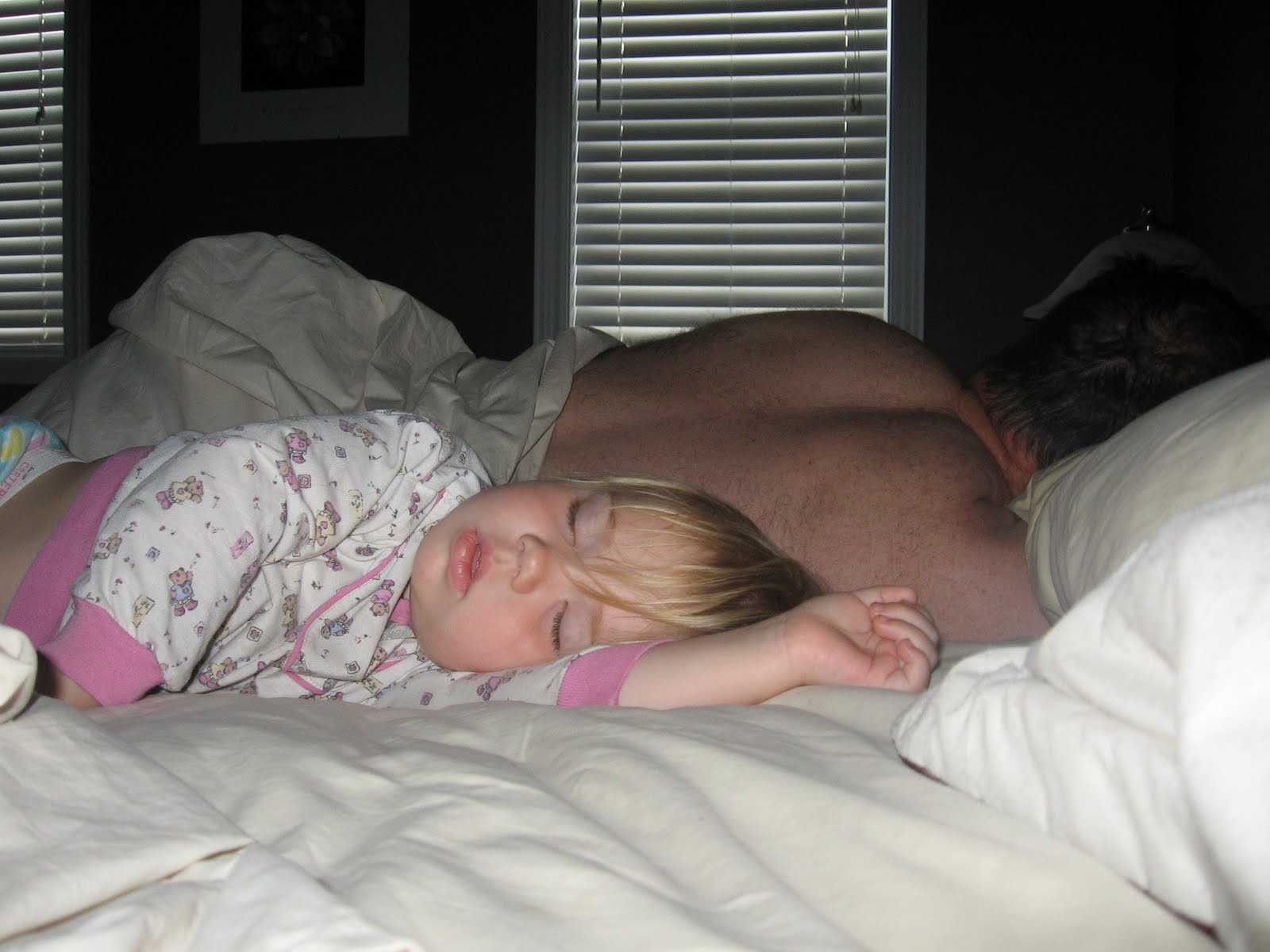
Who wants to sleep alone?


Last week, my husband and I watched Paranormal Activity 2, a prequel to the first movie that documented a couple who were being harrassed by a demon (not really, it's a movie-not-a-documentary). The prequel lays the foundation for the 'why' of the original movie, the demon has come to claim a family's firstborn son, an infant. The mother catches on pretty quickly to their new houseguest, but despite her fear, junior naps and sleeps in a crib in a separate room from the parents. I mean, really? Really???? You have a demon in your house, and you're not going to at least co-sleep? After the movie ended (sorry, I won't spoil the ending for you, you'll have to rent it), I took Grace out of her bed and brought her to bed with us. Yeah, I know it's a movie, but you can never be too safe, right? Right???


When we brought our first baby home, we co-slept with her for a few weeks, setting up a basinette in our bedroom, she was moved into her crib in a separate room when she was about eight weeks old. At the time, we had never even entertained the idea of bed-sharing. We moved Maddy into her room because that's what we thought we were 'supposed' to do -- conventional wisdom dictates that babies sleep in cribs. I can still remember the panic I felt at having her sleep apart from us. I kept a monitor in her crib, close to her face, I turned the speaker as loud as possible so I could hear her breathing. When I wasn't satisfied I could hear anything, I would creep into her room and check on her. Our (my) plans for a restful night's sleep were sidelined by worry and middle-of-the-night feedings.


When our second baby was born two years later, we kept her in our bed from day one. Maddy was sleeping through the night at that point, and we were worried that having a baby crying in her crib in the middle of the night would wake Maddy up as well. Once we started bed-sharing, we never looked back. Having Hannah in bed with us was reassuring, and the middle-of-the-night feedings were much easier to deal with. Instead of getting out of my bed, walking to a separate bedroom, and picking a baby up so that I could nurse her in a rocking chair, I simply rolled over, unclipped my nursing bra, and latched her on. I would often sleep through her feedings, as long as my breast was within reach, she would simply latch on and off throughout the night as needed. I was never worried about her safety in our bed -- I kept a pillow between Hannah and my husband, he's a deep sleeper, I wanted to make sure there was a barrier keeping him away from her. When I was facing Hannah, I would curl myself around her, when I would turn away from her, she would always shimmy herself close to my back. I made sure our covers were always pushed down so that nothing covered her face. Once Hannah was mobile, we started putting her down into her crib at the start of the night, I would nurse her down in the rocking chair, then transfer her to the crib. When we went to bed, I would bring her to bed with us, as long as she was nursing through the night, she slept with us. When Hannah was old enough to sit up, we would put a basket of toys in the bed, and if she woke up early, she would play between us while we slept -- it would only buy us an extra 20-30 minutes of shut-eye, but any parent knows how valuable that can be! What about our love life, you ask? There are other rooms in the house. We managed to conceive two more babies. Clearly, it didn't take a hit.


At the time, we endured plenty of comments from concerned family members (aka my mother) who insisted we were forming poor sleeping habits. Our child would never learn to soothe herself to sleep, and she would never be comfortable sleeping by herself. In short, we were 'breaking' our child by bed-sharing with her. When Hannah was 2.5 years old, we were expecting our third child. Hannah weaned at night shortly before he was born, and we moved her into her own bed in her own room. Was it hard? Not at all! In fact, we had an easier time transtitioning Hannah from our bed to her own bed than we did transitioning Maddy from the crib to her own bed. Furthermore, Hannah was much more secure sleeping by herself -- to this day, Maddy will not sleep with the door shut (she won't even go upstairs by herself during the day!).


When Owen was born, he slept in our bed (the same place he was born!). We had a harder time transitioning him out of our bed, he was almost three years old when Grace was born. It took a little while to figure it out, but Owen was just lonely at night by himself. We managed to transition him into Hannah's bed, he bed-shared with her for a little while, then we put a second twin bed in her room, and they shared a room. Owen is just a kid who doesn't like to sleep alone. He's five now, and he shares a room with Grace -- Grace slept in our bed until she was almost 2.5 years old, moving out of our bed into her own was easy. She's always been an independent child (understatement of the century!), she wants to do what the big kids do.


So all of the kids sleep in their own beds now, they all have different sleep habits, but we never had to 'train' any of them to sleep. I'm a firm believer that kids are born with different sleep habits, there will never be a 'one size fits all' approach to getting them to sleep. All you can do is adapt to their needs, you certainly can't 'ruin' a child by sleeping with them. Even now, I still occasionally bed-share with the kids, not because they want to, but because I do. When my husband goes out of town, I usually end up bringing one of them into our bed. I'm a big fraidy-cat, and besides, who wants to sleep alone?

Sunday, February 6, 2011

flippin' awesome!


Since becoming parents over a decade ago, my husband and I have recorded very little footage of our children, and it's something that I already regret. We've purchased various devices over the years with the intent to capture memories on film, both for our sake, and our children's sake, but we never really used any of them, save for a clip here and there. I have no video footage of myself as a child, I'm envious of people lucky enough to have home movies. The closest thing I have is a grainy video from our wedding with really bad sound, as bad as it is, I still like to watch it once in a while to see and hear my Dad.

This vacation, however, all of that has changed. I purchased a flip video camera (ultraHD 8GB, $179.99) for my business for the purpose of recording product reviews and tutorials. I didn't really intend to use the camera on vacation, I'm technically-challenged (understatement of the century), and I assumed it would take a while to figure it all out. Do you want to know how quickly I managed to figure it all out? I was recording footage withing two minutes of pulling out of the store's parking lot! The flip camera is *that* easy to use. One button start & stop, what could be easier than that? The camera comes with a small user guide, but it's interface is quite intuitive, other than a quick skim-through, I didn't really bother with the user guide.

The camera is very small, not much bigger than a cellphone, so it's easy to stow in my purse, it's always charged, so I've always got it handy, 'just in case'. So far, I've recorded 72 clips (!!!). Yes, I've gone completely overboard, I've already pared some of the videos down, the camera's preloaded software is rudimentary, but it allows me to edit the videos to the best of my ability (let's face it, I'm not going to get an Oscar for anything I record anytime soon). I can trim videos (cut off footage at the beginning and the end), merge videos, add music and titles -- I really have no need to do anything more than that. The preloaded software also gives me the ability to create still pictures from video footage, I haven't had the chance to get any developed yet, but given the quality of the video footage, I expect the stills will turn out well.

Downloading footage from the flip is quite easy, an attached USB arm, combined with its preloaded software, makes the task of storing video files a breeze. I simply plug the device into my laptop, and videos are saved to a folder (named with the month and year) and removed from the camera, while recharing the camera's battery at the same time. I don't have to fuss with cables or a charger, and I don't have to worry about video files being stored in 7 million diferent folders. It's a genius device, to be sure.

The high definiton video footage recorded by the flip camera is pretty great -- incredibly crisp, with clear audio. Image stabiliazition means the resulting footage is not shaky, no matter what I'm recording (if I'm walking and recording, the footage is remarkably steady). The camera's preloaded software makes it easy to share videos on various social media websites, though I've only uploaded videos to my Facebook account manually, I do not give any application access to my Facebook profile.

As great as this camera is, there are a couple of things I would change if I could. The zoom is not very powerful, it's sort of useless (I call it the 'baby zoom' when I'm recording -- and yes, I have to narrate everything). You're better off moving closer to whatever you're recording if you can, but in some instances (on a whale-watching tour, for example), that's impossible. The camera isn't great at recording in a dark setting, the resulting footage is grainy and unfocused (not that we record a lot at night, get your mind out of the gutters!). We took the flip to a family dinner last night, the restaurant's lighting was quite dim, and the resulting footage is not very clear. The power button is easy to turn on accidentally, though if unused for a short period, the camera shuts itself off.

Overall, I'm very (very!) pleased I made this purchase. The flip camera will be a great asset to the business -- our YouTube channel will be functional shortly, I think it will be a great way to connect with people about the products we sell. As a side benefit, our kids will one day be able to view snips and clips of their childhood. If they ask about life prior to 2011, I'll just have to tell them video cameras didn't exist (it will be our secret, right?).